


For my outdoor landscape photography, the first decision is when to go. I favour early morning or the period approaching sunset, and watch the forecast for cloud. As well as catching colour, clouds can help balance the sky with the land or water below, giving me more to work with when composing the photograph.
Once on location, I consider where to stand, what sits behind the subject and which distractions I can exclude. Good light does not resolve a cluttered background or an awkward overlap between objects. Those need attention when framing the photograph.
The photographs in this article provide examples of how viewpoint, light and colour affect what you notice in an image.

Sunset Colours lighting the Public Footpath: Fulking West Sussex, England
Choosing Where to Stand
On location, my position affects both the subject and what appears behind it. Moving sideways can separate overlapping objects; changing camera height can place the subject against a different part of the background.
In the Derbyshire cottage photograph below, the stone walls and road give the view depth, while branches frame the building from above. These elements contribute to the composition because of their relationship to the cottage, rather than simply because the picture contains lines.
Look around the edges before releasing the shutter. A partly included object or a bright patch near a corner can compete with the subject. Sometimes a small change of position is enough to exclude it without losing the surroundings that make the photograph interesting.
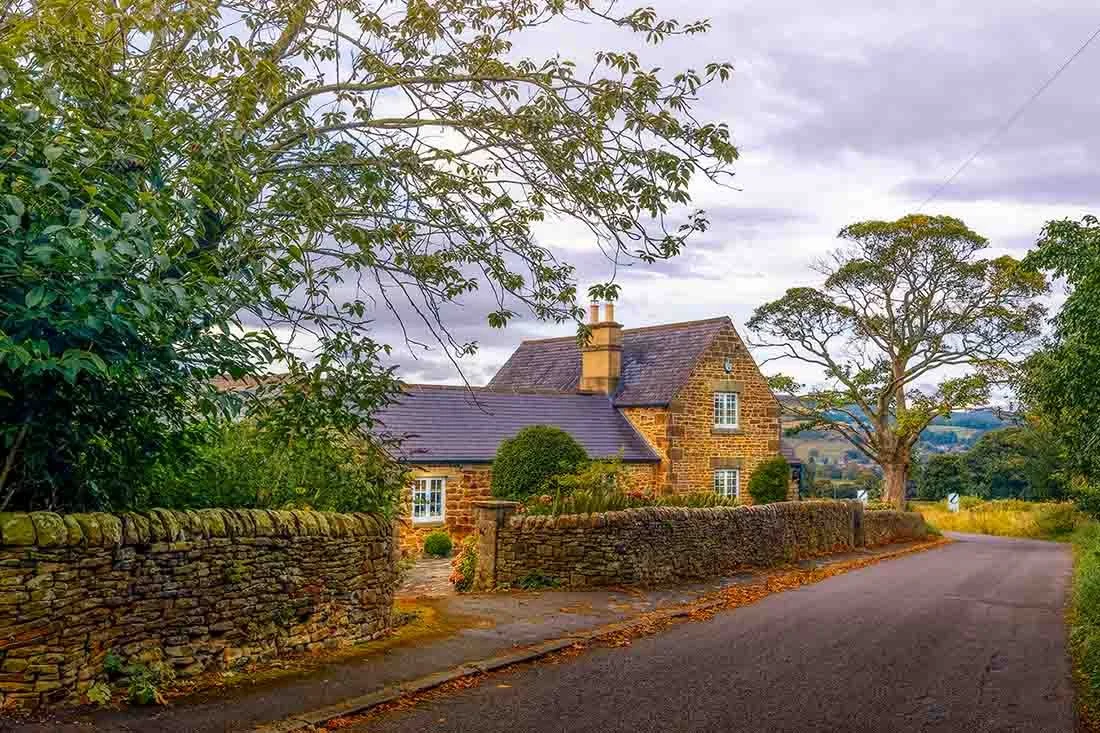
Around the Peak District in Derbyshire, England
When Colour Helps—and When It Distracts
In the Faro street photograph near the beginning of this article, the yellow façade stands out against the blue sky. The large areas of contrasting colour give the picture much of its structure; the repeated windows and dark balcony shadows break up the yellow wall.
Colour can also compete with the subject. The blue parking sign near the upper-left corner attracts attention even though it occupies relatively little space. When framing a scene, consider whether a strong colour belongs to something you want the viewer to notice.
The Fulking footpath photograph below works differently. Warm light falls across the fence and foliage, while the shaded areas remain darker. Here, the difference in brightness helps define the opening in the fence. Increasing colour saturation would not replace that separation between light and shade.

Balancing the Elements in the Frame
In the Old Ferry Bridge photograph below, the bridge forms a strong horizontal line across the picture. Its support and reflection add a vertical shape, while the church tower provides a separate point of interest above the trees.
The overhanging branches occupy the upper-left corner, balanced by more open sky towards the right. Balance does not require equal amounts of detail on both sides of a photograph.
How much space you leave around these elements changes their importance. A tighter crop around the bridge would reduce the role of the river and its reflections. Including more sky would give greater weight to the clouds and tower. Compare those choices by asking what each area contributes, rather than placing the main subject on a grid automatically.

The Old Ferry Bridge in Burton on Trent, Staffordshire, England
Balancing the Elements in the Frame
In the Old Ferry Bridge photograph below, the bridge forms a strong horizontal line across the picture. Its support and reflection add a vertical shape, while the church tower provides a separate point of interest above the trees.
The overhanging branches occupy the upper-left corner, balanced by more open sky towards the right. Balance does not require equal amounts of detail on both sides of a photograph.
How much space you leave around these elements changes their importance. A tighter crop around the bridge would reduce the role of the river and its reflections. Including more sky would give greater weight to the clouds and tower. Compare those choices by asking what each area contributes, rather than placing the main subject on a grid automatically.

Swans on the River Trent, Burton upon Trent. Their position and the trails they leave across the reflections make timing part of the composition.
Conclusion
Photography is a journey filled with exploration and growth. The importance of composition and colour cannot be overstated; they are the lifeblood of impactful photography. I invite fellow photographers, whether beginners or seasoned pros, to embrace these elements wholeheartedly. The more you explore and experiment, the more you will discover your unique style and voice.
As I continue on this journey, I look forward to the endless possibilities that await, knowing that every photograph is an opportunity to capture not just a moment but a story—one framed with intention and painted with colour.

South Downs National Park, West Sussex, England
